
Admin Console Overview
Open App Launcher (the grid icon) → REDA Financials AI - Admin → Financial Admin Console. Select Connections for service credentials; the other tabs contain Financial Setup, CoA & Tax Seeding, Territory Management, Accounting Periods and Operations. Assign the appropriate Financials administrative role. Saving connection credentials also requires Customize Application; do not grant it to ordinary accounting users.
Current main release: 1.62000
Native package licences. Salesforce package licensing replaces the old custom User activation checkbox and REDA-key seat/document enforcement. AI usage reporting remains. Assign native licences and roles; remove the retired checkbox from custom layouts.
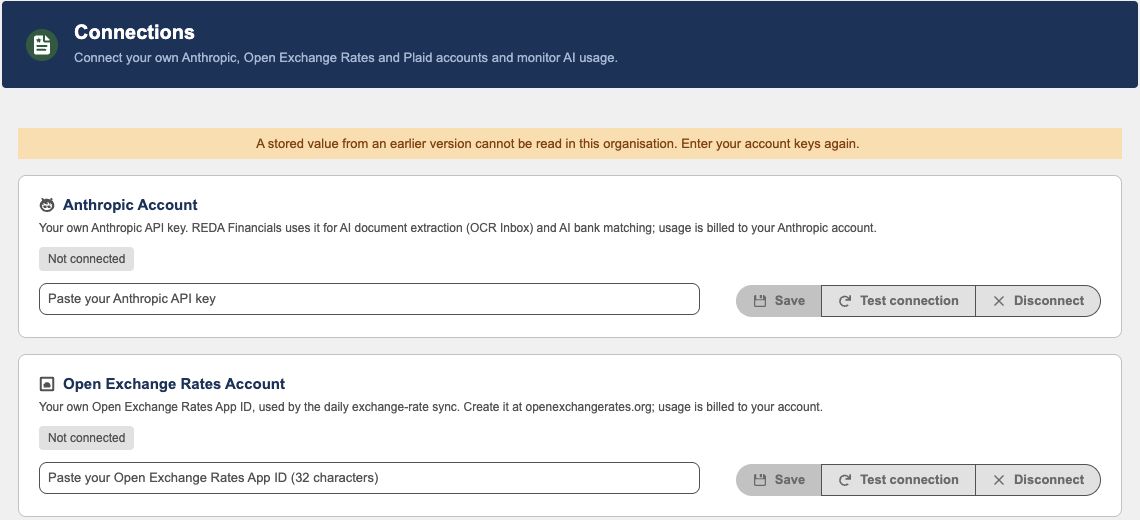
Your AI and FX accounts. Connections provides Save, Test connection and Disconnect for your Anthropic key and Open Exchange Rates App ID. Configure and test each service. Retire the AI Model Tier setting; Economy/DeepSeek instructions no longer apply.
Connect and manage banks. Built-in Plaid uses your organisation's provider account. Bank Accounts gain Connect Bank Feed; feed records gain Manage Bank Feed. Add actions, permissions and endpoint activation checks. Connect each bank, then explicitly sync or schedule.
Release notes and cumulative changes · Detailed installation and upgrade steps
The six tabs
| Tab | What you do there | Guide |
|---|---|---|
| Connections | Configure and test your organisation’s service connections. | Open App Launcher → REDA Financials AI - Admin → Financial Admin Console → Connections. An authorised administrator enters the organisation’s Anthropic key, Open Exchange Rates App ID or Plaid credentials as needed, clicks Save, then Test connection. A successful save alone does not prove the provider accepted the credentials. See the Connections: your AI, exchange-rate and Plaid accounts. |
| Financial Setup | Global Accounting Defaults (the GL accounts, ledger and framework every new entity inherits) and REDA Application Settings — currently a single org-wide switch, Multi-Currency. | Financial Setup Tab |
| CoA & Tax Seeding | Seed the global chart of accounts and per-country tax packs — the fastest route from empty org to working books. | CoA & Tax Seeding Tab |
| Territory Management | The 2-level territory hierarchy behind data access and hierarchical defaults. | Territory Management Tab |
| Accounting Periods | Generate each territory’s 12-period fiscal calendar. | Accounting Periods Tab |
| Operations | Schedule and monitor every automated batch job. | Operations Tab |
A quick finder — task to tab
When you know what you need to do but not where, use this table. Each row is a job an administrator actually does, mapped to the tab (and the card or section inside it) where it happens:
| You need to… | Go to | What you'll use |
|---|---|---|
| Connections | Connections | Open App Launcher → REDA Financials AI - Admin → Financial Admin Console → Connections. An authorised administrator enters the organisation’s Anthropic key, Open Exchange Rates App ID or Plaid credentials as needed, clicks Save, then Test connection. A successful save alone does not prove the provider accepted the credentials. See the Connections: your AI, exchange-rate and Plaid accounts. |
| Package licences and role access | Setup → Installed Packages → REDA Financials AI → Manage Licenses | In 1.62000, check native package licences at Setup → Installed Packages → REDA Financials AI → Manage Licenses where individual licences apply, then assign the appropriate Financials permission set. The retired User checkbox and REDA activation key do not enable access. See the Assign package licences and roles. |
| AI usage and provider limits | Financial Admin Console → Connections; provider usage/billing account | Financials retains AI usage reporting. In 1.62000 the old custom document-cap enforcement is retired; provider billing, funding and service limits belong to your organisation’s provider account. Check the reporting period and the provider’s usage/billing view. See AI usage reporting and provider billing. |
| Change a default GL account (Default AR, Default Revenue…) | Financial Setup | The Global Accounting Defaults section — a single-record editor of the org-wide defaults |
| Turn an application setting on or off | Financial Setup | The REDA Settings section — toggle, text and number editors, saved within a few seconds |
| Load the chart of accounts or a country tax pack | CoA & Tax Seeding | The seeding wizard — pick a country, preview what will be created, then seed |
| Add a country or region to the hierarchy | Territory Management | The territory hierarchy manager |
| Open a new fiscal year | Accounting Periods | The period generator — territory + year + calendar-or-custom fiscal choice → 12 periods |
| Schedule nightly automation, or run a batch right now | Operations | The scheduler cards — Schedule, Unschedule, Run Now |
| Check what last night's automation did | Operations | Each card's Last Run line and its View Audit Log link |
A closer look at each tab
Financials retains AI usage reporting. In 1.62000 the old custom document-cap enforcement is retired; provider billing, funding and service limits belong to your organisation’s provider account. Check the reporting period and the provider’s usage/billing view. See AI usage reporting and provider billing.
Financial Setup has two halves. Global Accounting Defaults is one record edited in place: the Default AR, AP, Cash, Unapplied Cash, Unapplied Payments, Revenue, Expense, Retained Earnings and FX Gain/Loss accounts, the intercompany receivable and payable accounts, the Default Ledger and the Reporting Framework. REDA Settings below it lists the application settings as rows — each a toggle, text box or number — and saves your change asynchronously within a few seconds.
CoA & Tax Seeding is a wizard, not a form: choose a country, see a preview of exactly what will be created, then seed. Territory Management draws the hierarchy your data access and defaults hang from. Accounting Periods asks for just a territory, a year, and whether the fiscal year follows the calendar or a custom start — and generates the 12 periods.
Operations introduces itself in one sentence on the tab itself: “Operations — Monitor and control automated batch jobs. Schedule the Recurring Transactions and Journal Entry Auto-Reversal batches to run daily at configured times, view last run outcomes, and trigger one-time manual runs.” Eleven cards cover recurring transactions, journal-entry auto-reversal, four auto-apply batches, expense allocation, aging snapshots, OCR processing, FX rate sync and asset depreciation. Every batch writes an entry to the Audit Log, and each card reads it back as its Last Run line.
First-time setup order
The tabs read left to right for a reason — it’s the natural install sequence:
- In 1.62000, check native package licences at Setup → Installed Packages → REDA Financials AI → Manage Licenses where individual licences apply, then assign the appropriate Financials permission set. The retired User checkbox and REDA activation key do not enable access. See the Assign package licences and roles.
- CoA & Tax Seeding — seed the Global CoA pack first, then each operating country.
- Territory Management — create your countries/regions.
- Financial Setup — confirm the global defaults the seeding created; tune application settings.
- Accounting Periods — generate each territory’s fiscal year.
- Operations — schedule the overnight automation.
Then leave the console — entities, products, customers and vendors are created in the apps themselves. The Your Setup Roadmap carries the full journey.
A worked example — Meridian's first hour in the console
In this example, an administrator prepares Financials 1.62000 for a new organisation. The sequence below illustrates the setup tasks.
Connections
The administrator opens Connections, enters the organisation’s provider credentials, saves, then tests each required service. A successful connection does not schedule processing; schedule the relevant job later.
CoA & Tax Seeding — load the books' skeleton
She seeds the Global CoA pack first, then the tax packs for each country Meridian operates in — the wizard previews every record before creating anything.
Territory Management — draw the map
Territories for the United States, United Kingdom, India and Brazil go into the hierarchy — the structure entities, periods and data access will hang from.
Financial Setup — confirm the defaults
She reviews the Global Accounting Defaults the seeding created — Default AR, Default Revenue, Retained Earnings and the rest — and walks the REDA Settings rows, watching each save confirm within a few seconds.
Accounting Periods — open the year
One run of the generator per territory: territory + 2026 + the fiscal-year choice, and 12 periods appear for each.
Operations — switch on the automation
She schedules the batches Meridian needs to run daily, each with its own time, and leaves the rest showing Not Scheduled until the books need them.
Common mistakes to avoid
| Mistake | Why it hurts | Do this instead |
|---|---|---|
| Generating periods before creating territories | The period generator works per territory — with no territories, there is nothing to generate for | Territory Management first, then Accounting Periods |
| Skipping the Financial Setup review after seeding | A missing global default (say, no Default AR account) surfaces later as a posting failure, at the worst possible moment | Walk every field of Global Accounting Defaults once seeding finishes |
| Check available native package licences before onboarding users. | Permission sets, package licences and record access are separate. Review each when assigning or removing access. | Follow the licence-assignment guide to add or remove users; confirm the final assignment list. |
| Leaving every Operations card on Not Scheduled | Recurring documents never generate, auto-reversals never post, snapshots go stale — silently | Schedule the batches your books rely on as the last step of setup |
| Configuring by editing raw records instead of using the console | You bypass the validation, previews and idempotent seeding that make configuration safe | Do it in the console; that's what it's for |
Who sees it
Open App Launcher → REDA Financials AI - Admin → Financial Admin Console. Use the permissions appropriate to each administrative task. Saving service credentials specifically requires Customize Application; an accounting role alone does not grant it. Do not give that broad permission to every accounting user.
Where to go next
- Open App Launcher → REDA Financials AI - Admin → Financial Admin Console → Connections. An authorised administrator enters the organisation’s Anthropic key, Open Exchange Rates App ID or Plaid credentials as needed, clicks Save, then Test connection. A successful save alone does not prove the provider accepted the credentials. See the Connections: your AI, exchange-rate and Plaid accounts.
- Post-Installation Setup — the console in the install story.
Frequently asked questions
Switch to the REDA Financials AI – Admin app (App Launcher) and check you hold the Accounting Admin permission set. The console is deliberately invisible to non-admin roles.
It’s the intended one — everything in it can technically be reached through raw record editing, but the console adds the guardrails (validation, previews, idempotent seeding) that make configuration safe. Use the console.
Wait for the specific operation’s completion message. Connection saves can finish asynchronously; then use Test connection. A saved configuration or a scheduled job does not prove the provider accepted a credential or that a processing run succeeded.
Verify the actual execution user and access required for the scheduled job or integration in your organisation. Do not assume automation is universally exempt from native package licensing. A permission-set assignment and a package licence are separate checks.
Two places, one source. Each Operations card shows its Last Run and outcome, and its View Audit Log link opens the underlying entry — every batch writes one, with a summary like “Processed X | Success Y | Failed Z”. See Audit Logging.
Yes — seeding is idempotent, and the wizard shows a preview of what a run will create before it does anything. Re-running doesn't duplicate what already exists. See the CoA & Tax Seeding Tab guide.
Was this article helpful?